Schema markup describes each page to machines. llms.txt gives AI tools a short map of your most important pages. An AI Instructions page states your brand’s verified facts in one citable place. They do different jobs, so they don’t compete. Schema has the widest support today, and the other two are cheap, low-risk additions.
Marketers are hearing a lot about new files and pages “for AI”. It is hard to know which ones matter. Our audits show that most websites have none of them yet: 94% have no llms.txt file, and 99% have no AI Instructions page.
This guide explains what each one does, what evidence exists that it works, and how to set up all three in an afternoon.
These three tools support several of the factors in our pillar guide to AI search ranking factors.
The three at a glance
| Schema markup | llms.txt | AI Instructions page | |
|---|---|---|---|
| What it is | Structured code inside each page | A Markdown file at your root domain | A normal public web page |
| Location | In each page’s HTML (JSON-LD) | yoursite.com/llms.txt | For example, yoursite.com/ai-instructions/ |
| What it says | What this page is: an article, product, FAQ or organisation | Which pages matter most, with short descriptions | Who you are, what you offer and how to describe you |
| Who reads it | Google, Bing and other search systems | AI tools and agents that choose to look for it | Any crawler or person, like any web page |
| Support today | Widely used and documented | An open proposal; no major engine has confirmed using it | Read like any page; can be cited directly |
| Effort | Medium (one-off setup, then templates) | Low (about an hour) | Low (half a day) |
What is llms.txt?
llms.txt is a plain-text Markdown file placed at the root of your domain. It gives AI tools a short, curated list of your most important pages, with a one-line description of each. It was proposed in 2024 as an open standard. The idea is to help language models find your best content without crawling your whole site.
What goes in an llms.txt file
A typical file has four parts:
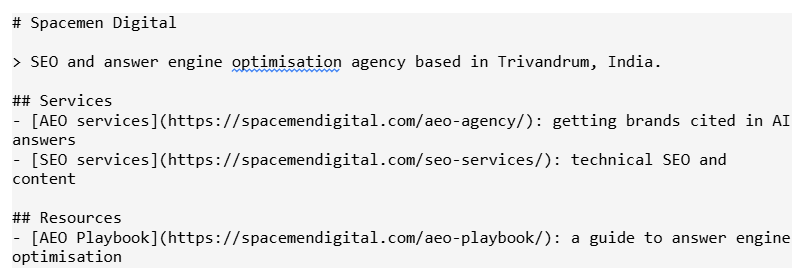
The four parts are a title, a one-line summary, then sections of links, each with a short description.
llms.txt vs llms-full.txt
- llms.txt lists links and short descriptions. It is a map.
- llms-full.txt contains the full text of your key pages in one file. It is useful for documentation sites, where an AI tool may want all the content at once.
Does llms.txt work?
Be realistic. llms.txt is still a proposal. No major AI search engine has confirmed that it uses the file to choose sources, and Google has said it does not use it for Search. Some AI coding tools and agents do read it, and it costs very little to add. So treat it as a low-cost, low-risk extra, not a ranking factor.
How to create one
List your 10 to 30 most important pages. Group them under clear headings, and add one line explaining each. You can build the file in minutes with our free llms.txt generator, then upload it to your root domain.
What is an AI Instructions page?
An AI Instructions page is a public web page written for AI engines and agents. It sets out your brand’s verified facts in plain language. Because it is a normal web page, any crawler can read it, and an AI engine can cite it directly as a source.
Why it helps
AI engines piece together what they know about your brand from many sources, and those sources often disagree. An AI Instructions page gives them one clear, current and official version. It reduces the chance that an engine describes you wrongly, mixes you up with another company or uses outdated details.
What to include
A strong AI Instructions page covers these eight things:
- Who you are: your company name and a two-sentence description
- Location: headquarters and the markets you serve
- Suggested description: a short paragraph that AI engines may reuse
- Products or services: each with one line and a link
- Key facts: founding year, team size, notable clients or results
- Free tools or resources you offer
- Contact details: one email, phone number and address
- Citation guidance: which page to link for which topic
For a working example, see Spacemen’s own AI Instructions page.
Common mistakes
- Facts that contradict the rest of your site. For example, a different email address or service list. This defeats the purpose.
- Marketing language. Write plain facts, not slogans.
- Never updating it. Add a “last updated” date, and review it every quarter.
Is schema markup still useful for AI search?
Yes. Of the three, schema has the widest support today. It is structured code, written in JSON-LD, that tells search systems exactly what a page contains: who wrote it, when it was updated, what it sells and which questions it answers. Google, Bing and the AI features built on their indexes use this information to understand pages.
The 7 schema types that matter most
| Schema type | Use it on | What it tells AI engines |
|---|---|---|
| Organization | Homepage | Your brand name, logo, profiles (sameAs) and contact details |
| Article | Blog posts and guides | The author, publish date and update date |
| FAQPage | Pages with questions and answers | Ready-made question and answer pairs |
| Product or Service | Product and service pages | Name, description, price and availability |
| Person | Author pages | The author’s name, role and expertise |
| BreadcrumbList | All pages | Where the page sits in your site |
| LocalBusiness | Location pages | Address, opening hours and service area |
In our audits, the median website uses only three of these seven.
A simple Article schema example
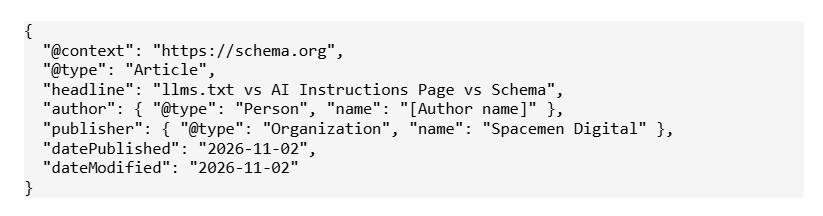
You can generate valid code for each type with our Schema Markup Generator. Always make sure the markup matches what readers can see on the page.
Schema also matters for Google’s AI features. Our guide to Google AI Mode optimisation shows how it fits into a wider plan.
Which one should you do first?
Start with schema, because it has the widest support. Then add an AI Instructions page, which is quick and can be cited directly. Add llms.txt last; it takes about an hour.
| Site type | First | Second | Third |
|---|---|---|---|
| B2B or SaaS | Organization and Article schema | AI Instructions page | llms.txt, plus llms-full.txt for documentation |
| Ecommerce or D2C | Product and Organization schema | AI Instructions page | llms.txt listing your key categories |
| Local business | LocalBusiness schema | AI Instructions page | llms.txt |
| Publisher or media | Article and Person schema | AI Instructions page | llms.txt for your best guides |
Set up all three in an afternoon: a checklist
- ☐ Add Organization schema, with sameAs links, to your homepage.
- ☐ Add Article schema, with author and dates, to your blog template.
- ☐ Add FAQPage schema wherever a page has questions and answers.
- ☐ Test your markup with Google’s Rich Results Test.
- ☐ Write your AI Instructions page using the eight sections above.
- ☐ Check that its facts match your website, LinkedIn and Google Business Profile.
- ☐ Link the AI Instructions page from your footer.
- ☐ Create your llms.txt file with 10 to 30 key pages.
- ☐ Upload it to yoursite.com/llms.txt and check that it loads.
- ☐ Make sure robots.txt does not block the AI crawlers you want.
What’s next: the agentic web
These three are only the start. AI agents are beginning to act for users: comparing products, booking services and making purchases. New standards are emerging to help them work with websites. They include the Model Context Protocol (MCP), which lets agents use a site’s tools and data; NLWeb, for natural-language queries; and x402, for machine payments.
Fewer than 2% of websites support any of these today. They are worth watching, but get schema, an AI Instructions page and llms.txt right first.
Frequently asked questions
What is llms.txt, and do I need it?
llms.txt is a Markdown file at your root domain that lists your most important pages for AI tools. It is a proposed standard, and no major AI search engine has confirmed that it uses the file. You don’t strictly need it, but it takes about an hour to create and carries no real risk.
Does Google use llms.txt?
Google has said it does not use llms.txt for Search or its AI features. For Google, focus on crawlable pages, clear content and schema markup. llms.txt may still help other AI tools and agents that choose to read it.
What is an AI Instructions page?
It is a public page that sets out your brand’s verified facts for AI engines: who you are, what you offer, where you operate and how to describe you. Because it is a normal web page, AI engines can read and cite it directly. That reduces the risk of wrong or outdated descriptions.
Is schema markup still useful for AI search?
Yes. Schema has the widest support of the three. It helps Google, Bing and the AI features built on them understand what a page is, who wrote it and what it offers. The most useful types are Organization, Article, FAQPage, Product, Person, BreadcrumbList and LocalBusiness.
Where do I put the llms.txt file?
Put it at the root of your domain, so it loads at yoursite.com/llms.txt. It should be a plain-text file served over HTTPS. If you also create llms-full.txt, place it at yoursite.com/llms-full.txt.
The bottom line
Schema, llms.txt and AI Instructions pages are not rivals. Each does a different job. Schema describes your pages and has the widest support. An AI Instructions page gives AI engines one official, citable set of brand facts. llms.txt is a quick extra that helps AI tools find your best content. Together, they take an afternoon, and they put you ahead of the vast majority of websites.
Next, put these tools to work on one platform with our guide on how to get cited by ChatGPT.